
Lead almost never leaves a Florida water plant. Where it turns up in tap water, it comes from the pipes on the way to the house, and above all from the service line, the pipe that runs from the water main in the street to your meter and on to your home. For most of the last century nobody kept good records of what those pipes were made of. That has changed, and you can now look yours up.
Why there is an inventory at all
Under the federal Lead and Copper Rule, every community water system had to build an inventory of its service lines, both the utility-owned stretch and the customer-owned stretch to the house, and classify each one. The Florida Department of Environmental Protection, which runs the program in this state, has published guidance and a question-and-answer sheet for utilities on how to do it. The EPA’s 2024 update to the rule, the Lead and Copper Rule Improvements, goes further: utilities must replace lead lines within ten years of the rule’s compliance date, keep the inventory updated every year, and notify the households served by lead, galvanized or unknown lines after each update.
The result, for you, is a public record of what connects your home to the main.
The four categories
- Non-lead. Copper, plastic or another material confirmed by records or inspection. Nothing to do.
- Lead. A lead pipe on either side of the meter. The utility is required to replace it, and in the meantime you should treat your drinking water as if lead is present.
- Galvanized requiring replacement. Galvanized steel pipe that is, or ever was, downstream of lead. Galvanized pipe absorbs lead over the years and can release it later, so the rule treats it like lead.
- Lead status unknown. No record either way. This is the largest category in many Florida utilities. It is not a finding of lead; it means the line has not been verified yet, and the utility has to keep working through it.
The Department of Environmental Protection’s count as of December 2025 was 5,207 lead lines, 34,494 galvanized lines requiring replacement, about 5.9 million non-lead lines and 1.46 million unknown. Florida’s housing is younger than the Northeast’s, which helps; the unknowns are mostly older neighborhoods where records ran out.
How to look up your address
- Find your utility’s name on your water bill.
- Search online for that name plus “lead service line inventory”. Most Florida utilities have a page with an address lookup or a map; Gainesville Regional Utilities, for example, publishes one on its Lead and Copper page.
- Enter your address and read both halves: the utility side and the customer side. They can be different materials.
- If there is no lookup, call the number on the bill and ask for the service line material on record for your address. They are required to tell you.
- If you were sent a notice this year saying your line is lead, galvanized or unknown, that notice is the inventory result for your address.
What to do with the answer
Non-lead: nothing further for the service line. Lead can still come from solder in homes plumbed before 1986 and from older brass fixtures, so the cold-water and flushing habits below still apply in an older house.
Lead or galvanized: ask the utility when replacement is scheduled, and whether it will replace the customer side at the same time, which many programs now do. Until then, use cold water for drinking and cooking, run the tap until it is cold after it has sat for a few hours, and consider a filter certified to NSF/ANSI 53 for lead, or reverse osmosis, at the tap you drink from. The EPA’s Protect Your Tap guide walks through the same steps.
Unknown: the EPA’s own Protect Your Tap tool lets you check the pipe where it enters the house yourself with a coin and a magnet: lead is dull grey, scratches to a shine and does not hold a magnet. Report what you find to the utility; it counts toward verifying the line. Treat the water as the “lead” case until it is confirmed.
Where a home system fits
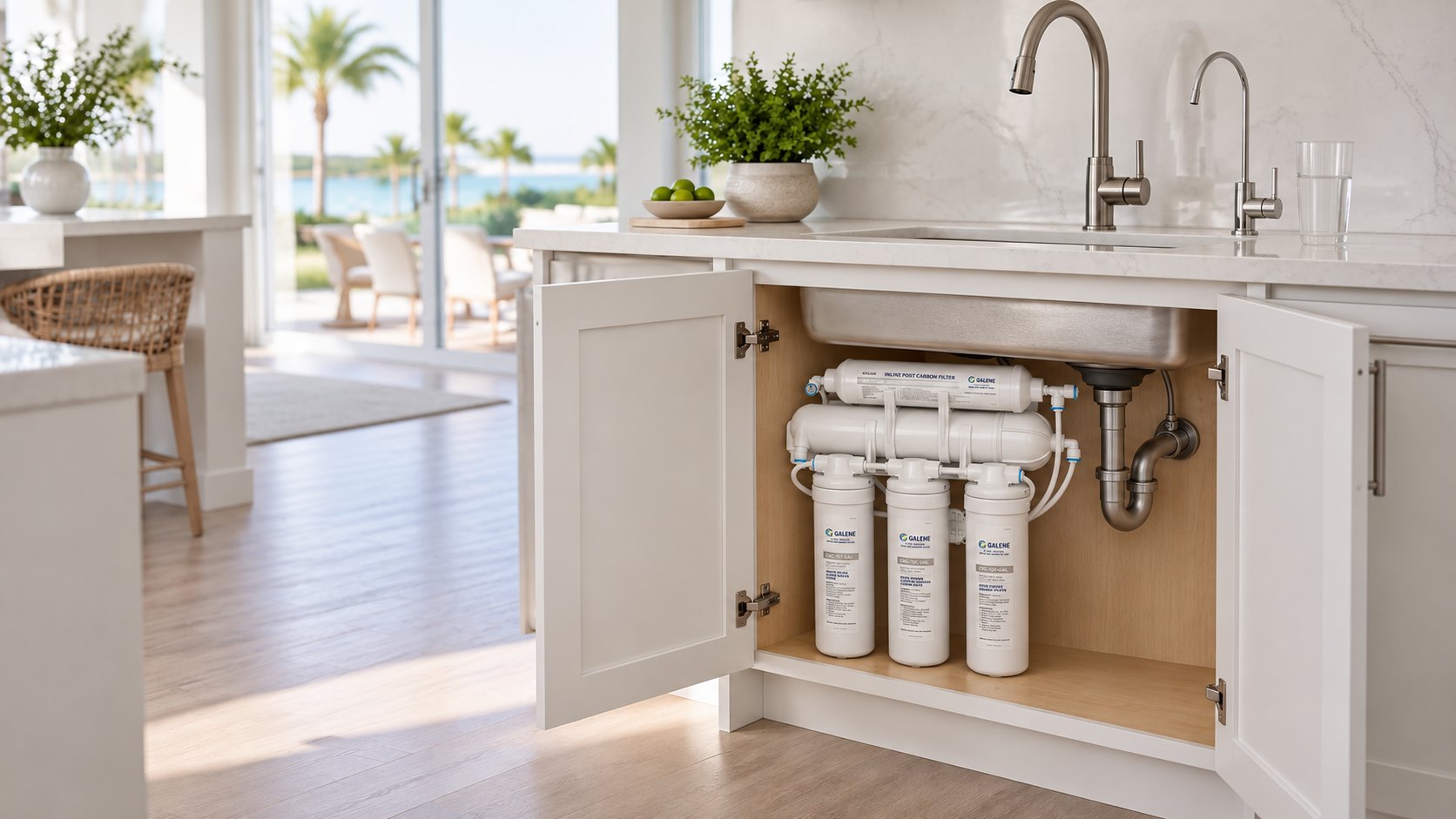
A service line replacement is the utility’s job and the real fix. A home system is the protection in the meantime, and the answer for the plumbing inside the house, which no utility program touches. Reverse osmosis at the kitchen sink is the most effective treatment for lead in drinking and cooking water; Galene’s RO-6Q and the tankless RO-6Q TL are certified under NSF/ANSI 58 and install in the cabinet under the sink. For the whole house, the RO-4 treats every tap.
We do not test for lead at the sink during a consultation, because lead needs a laboratory, but we will tell you whether your home’s age and your inventory result make a lab test worth doing, and how to get one. Request a free in-home consultation and bring your inventory lookup with you.
Common questions
- How do I find out if my service line is lead?
- Your water utility keeps a service line inventory and most Florida utilities have published it online with an address search. Search your utility’s name plus “lead service line inventory”, or call the number on your water bill and ask for the material of your service line.
- What does “lead status unknown” mean?
- The utility has no record of what the pipe is made of. It is not a finding of lead; it means the line has not been checked yet. Under the federal rule, unknown lines are treated as if they might be lead until they are verified.
- Does Florida have many lead service lines?
- Fewer than the older cities of the Northeast and Midwest. As of December 2025 the Florida Department of Environmental Protection counted about 5.9 million non-lead lines, 5,207 lead lines, 34,494 galvanized lines requiring replacement and 1.46 million still unknown. Roughly four in five lines are confirmed non-lead; the unknowns are still being verified.
Related on this site
Sources and further reading
- Florida Department of Environmental Protection: Lead Service Line Inventory questions and answers (PDF)
- Florida DEP Source and Drinking Water Program, 2026 update with statewide inventory counts (PDF, hosted by the Florida Rural Water Association)
- U.S. EPA: Lead and Copper Rule Improvements
- U.S. EPA: Protect Your Tap, a quick check for lead
- U.S. EPA: Basic Information about Lead in Drinking Water